
ChatGPT Ads: Is It Time to Add a Test to Your Media Plan?
- 9 min read
Highlights
- OpenAI's ChatGPT offers businesses a new digital advertising environment, enabling ad placement within user-led conversations to capture intent rather than just searches or demographics.
- ChatGPT does not allow organizations to influence its responses by buying ads. Ads appear below responses and are chosen based on relevance to the conversation's context and user intent.
- The platform, currently undergoing development, lets businesses experiment with their marketing strategy without shifting major parts of their advertising budget.
- The effectiveness of ChatGPT as an acquisition channel can be gauged through clicks and post-click actions, as opposed to impressions.
- Distinguished from Answer Engine Optimization (AEO), ChatGPT Ads can complement it instead of competing with it, both serving the purpose of increasing visibility within AI-led discovery.
For years, digital advertising has largely meant meeting people in one of two places: where they search or where they spend time. Google Ads captures people actively looking for something. Social advertising on platforms such as LinkedIn, Facebook and Instagram can reach people based on who they are, what interests them and the audiences they resemble. ChatGPT introduces another environment: the conversation people are having while trying to figure something out.
Someone might ask ChatGPT: “What should I look for when choosing a new association management system?” Or: “Our nonprofit website is ten years old and difficult to update. What should we prioritize in a redesign?” Or: “What are the best continuing education options for someone moving into cybersecurity management?”
These aren’t necessarily searches for a particular company. But they can reveal something extremely valuable to an advertiser: intent. That is what makes ChatGPT Ads interesting.
It does not mean every organization should immediately shift advertising dollars into ChatGPT. But for the right organization, 2026 may be the right time to add a controlled ChatGPT Ads test to the media plan.
What Are ChatGPT Ads?
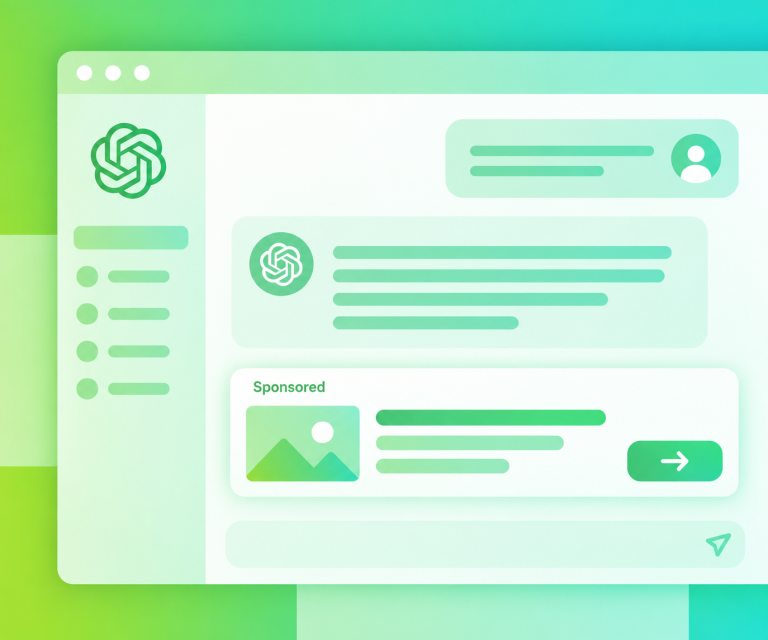
OpenAI began testing advertising in ChatGPT in the United States in early 2026 and has expanded the program significantly since then. Self-service access through Ads Manager expanded into additional international markets in August. Ads can appear below ChatGPT responses and are clearly identified as sponsored content. Importantly, the advertising system is separate from ChatGPT’s answers. Buying an ad does not make an organization more likely to be mentioned or recommended in the answer itself.
The opportunity is not to buy your way into ChatGPT’s answer. It is to make your advertising eligible to appear alongside conversations where OpenAI’s advertising system determines that your offering may be relevant.
OpenAI says ad selection can consider signals including the context and intent of the current conversation, the advertiser’s landing page, title and copy, advertiser-provided context hints and targeting selections. When a user has enabled ad personalization, additional signals from that user’s broader ChatGPT experience may also contribute to relevance.
ChatGPT advertising is also still a developing platform. Ads Manager remains in beta, and OpenAI continues to expand its campaign, measurement and optimization capabilities. For marketers, that is another reason to approach the channel as a test rather than assume it should immediately become a major part of the media budget.

Why ChatGPT Ads Could Be Valuable
Imagine that a professional association wants to recruit people early in their careers. On Google, the association might bid on searches such as “professional association for accountants” or “accounting certification.” Those searches are useful because the intent is obvious. But a potential member might be having a much broader conversation with ChatGPT: “I’ve been working in corporate accounting for three years. What should I be doing now if I want to become a controller eventually?”
That person hasn’t searched for an association. But the conversation may reveal that professional development, certification, networking or mentoring would be useful.
For an association offering those things, that’s an interesting context in which its advertising could potentially be relevant.
The same principle could apply to a university promoting a graduate program, a healthcare organization promoting an appropriate service, a B2B company selling specialized software, or an ecommerce company whose product solves a particular problem.
Instead of thinking only about what someone searched, marketers can begin thinking about what someone is trying to accomplish.
Who Should Consider Testing ChatGPT Ads?
Being able to advertise on a new platform is not a sufficient reason to do it. A stronger candidate generally has a clear audience, a clearly defined problem it solves and a meaningful action someone can take after clicking.
Consider a cybersecurity company selling employee security-awareness training. The company could potentially be relevant to conversational contexts involving questions such as:
“How can I reduce phishing risk among employees?”
“What cybersecurity training should a 200-person company provide?”
“Why do our employees keep falling for phishing simulations?”
The relationship between those problems and the advertiser’s solution is straightforward.
Now imagine a consulting company advertising simply: “We Help Organizations Succeed.” Even if that’s true, it provides very little information about when or why the company is relevant.
ChatGPT advertising reinforces a principle that is already important across paid media: specificity creates relevance.
Organizations with clearly defined products, services, audiences and problems are therefore likely to have the easiest starting point.
Don’t Start With a Huge Budget. Start With a Question.
New advertising channels create an understandable temptation to rush in before competitors do. A better approach is to treat the first campaign as an experiment.
For example, suppose an association has $40,000 per month in paid media spread across Google, LinkedIn and Meta. It doesn’t need to move half of that budget to ChatGPT.
It might instead establish a defined test budget and ask: Can ChatGPT generate qualified prospective-member traffic at a cost that makes it competitive with our existing acquisition channels?
Now the campaign has something to prove.
A B2B technology company might ask: Can we generate demo requests from ChatGPT at an acceptable cost per qualified lead?
A university might ask: Can ChatGPT contribute to inquiries from prospective students who are considering a career change?
The goal of the initial campaign isn’t simply to generate impressions. It is to learn whether this new environment deserves a larger place in the media mix.
Structure the Test Around Intent
ChatGPT Ads shouldn’t simply duplicate an organization’s Google Ads campaign.
OpenAI allows advertisers to provide “context hints” that give its advertising system additional information about what a product or service is, who it may help and situations in which it may be useful.
But context hints should not be treated like Google Ads keywords.
They are not exact-match keywords or instructions to place an advertisement against a particular question or conversation. They are signals that help OpenAI’s system determine when an eligible ad may be relevant.
That means marketers should think about the situations surrounding the purchase, not just the product name.
A company selling membership management software could think beyond terms such as:
- association management software
- membership database
- AMS platform
The more interesting contexts may involve problems such as:
- members can’t update their own profiles
- staff manually transfer information between systems
- event registration doesn’t communicate with the CRM
- membership renewals require too many manual steps
- association data exists in several disconnected platforms
These situations can eventually lead to buying decisions.
Your media team should therefore ask a different question during campaign planning: What needs, situations and problems tend to surround the moment when someone realizes they need what we offer?
Those situations can inform your context hints, but they should not be treated as a list of conversations in which your ads are guaranteed to appear. OpenAI’s system ultimately determines relevance and delivery.
Choose the Right Campaign Objective
A useful test also needs the right objective.
ChatGPT Ads currently provides three campaign objectives: CPM, CPC and conversion-optimized CPC.
A CPM campaign is designed primarily around reach and impressions. CPC campaigns focus on generating traffic, while conversion-optimized CPC campaigns are intended to drive actions that occur after someone clicks.
If a national organization simply wants to introduce its brand or a new initiative to a relevant audience, impressions may be a useful starting point.
But suppose a software company is trying to generate demonstrations. In that case, knowing that 100,000 people saw its advertisement tells the company relatively little about whether ChatGPT can become a productive acquisition channel.
For organizations evaluating ChatGPT as a performance channel, clicks and especially downstream conversions may provide much more useful evidence. The campaign objective should therefore follow the business question you established before the test began.
The Landing Page Matters More Than Ever
A highly contextual ad can lose its advantage immediately if it sends someone to a generic homepage.
Suppose a user is discussing: “How can our nonprofit increase recurring donations?” The user sees an ad from an agency promoting nonprofit digital fundraising services. They click. And arrive at a homepage that says: “Transforming Digital Experiences Through Innovation.” The connection has been lost. The visitor now has to figure out what the company does, whether it works with nonprofits and whether it can help with fundraising.
Instead, the landing page should continue the thought that prompted the click. A better page might lead with: “Turn More One-Time Donors Into Long-Term Supporters” It could then explain the agency’s approach to donation UX, campaign landing pages, marketing automation, analytics and conversion optimization, followed by relevant nonprofit examples and a clear call to action.
The conversation, ad and landing page should feel like three parts of the same journey.
Make Sure Measurement Is Ready Before Spending
One of the easiest ways to waste an advertising test is to launch it before agreeing on what success means.
OpenAI’s Ads Manager provides reporting that includes impressions, clicks, spend, click-through rate, average CPC, average CPM and conversions. But clicks alone won’t tell most organizations whether the channel works.
Suppose two campaigns each spend $5,000. Campaign A produces 1,000 visitors and 10 qualified leads. Campaign B produces 500 visitors and 25 qualified leads. If the team is primarily watching traffic, Campaign A appears stronger. If the business needs leads, Campaign B is clearly more valuable. Before launching, determine which actions matter.
Depending on the organization, that might include a membership application, donation, ecommerce purchase, demo request, consultation request, newsletter signup, event registration, application start or another meaningful conversion.
Make sure analytics and conversion tracking are functioning before the campaign launches. OpenAI supports conversion measurement through the OpenAI Pixel, Conversions API or both, while UTM parameters can help organizations analyze ChatGPT traffic within tools such as GA4.
And whenever possible, measurement shouldn’t stop at the form submission.
If ChatGPT generates 50 leads but none become customers, that’s important. If it generates 15 leads and five become major opportunities, that’s important too.
The ultimate question isn’t “Did ChatGPT send us traffic?” It is “Did ChatGPT contribute to outcomes that matter to the organization?”
ChatGPT Ads and AEO Are Not the Same Thing
This distinction will become increasingly important. There are now at least two ways an organization may try to gain visibility within AI-driven discovery.
One is paid visibility. You purchase ChatGPT advertising and compete for sponsored placements.
The other is earned visibility. Through Answer Engine Optimization, or AEO, you improve your digital content so AI systems can more easily discover, understand and evaluate information about your organization, expertise, products and services, increasing the opportunity for that content to be surfaced when relevant.
Imagine someone asks: “What should an association include in an RFP for a website redesign?” A digital agency could potentially appear in a sponsored placement related to that conversational context through ChatGPT Ads.
That agency may also pursue organic AI visibility by publishing authoritative, accessible content that AI systems can discover, understand and potentially cite or surface when responding to relevant questions.
The first opportunity is purchased. The second is earned. And buying the first does not buy the second.
OpenAI explicitly separates advertisements from ChatGPT responses. Advertisers cannot pay to influence, rank or alter the answers ChatGPT provides.
That makes ChatGPT Ads and AEO complementary rather than competing strategies.
Think of Paid Media and AEO as Two Doors Into the Same Decision
Consider a university trying to increase enrollment in an online master’s program in data analytics.
A prospective student asks ChatGPT: “I’m a financial analyst with five years of experience. What skills would help me move into data science without starting my career over?”
There are two opportunities.
Through AEO, the university can create authoritative, useful content about career transitions, analytics skills and graduate education that is structured so AI systems can readily discover and understand it.
Through ChatGPT Ads, the university may have an opportunity for a relevant paid message to appear alongside conversations where its program is a good match. The strategies operate differently, but the user’s journey is increasingly the same.
That’s why organizations should resist creating separate “AI marketing” silos. Search, content, AEO, paid media, conversion optimization and analytics are increasingly intersecting around the same customer questions.
What Would a Good ChatGPT Ads Test Look Like?
A useful pilot doesn’t need to be complicated. Start with one meaningful audience and one business objective.
For example, an association might focus on prospective members rather than trying to promote membership, conferences, certifications and publications simultaneously. Then select a defined offer.
Perhaps the association promotes a career-development resource that naturally leads into membership rather than immediately asking a person unfamiliar with the organization to pay annual dues.
Build several ad variations around different needs and situations. Rather than relying on one generic message, test different ways of communicating the specific benefit the organization provides. Send those visitors to a landing page built specifically around their intent. Make sure analytics and conversion tracking are functioning. Set a predetermined budget and testing period. Then compare the results against existing channels.
If ChatGPT produces qualified conversions efficiently, increase the investment and continue testing. If it produces traffic without meaningful engagement, investigate the audience, creative and landing page before increasing spend. And if the economics simply don’t work, keep the lesson and put the budget somewhere else.
A successful test doesn’t have to prove that ChatGPT Ads are wonderful. It has to produce enough information to make the next decision intelligently.
The Bigger Opportunity Is Understanding How Discovery Is Changing
ChatGPT Ads are worth watching because they represent more than another box in a media plan. They reflect a larger change in how people discover organizations and make decisions.
For years, marketers optimized around the search box. A person reduced a need to several words — “best CRM for nonprofits,” for example — and marketers competed to appear for those words. AI interfaces allow people to express much more: “We’re a 40-person nonprofit using Salesforce, but our fundraising team hates it and most donor information is maintained manually. What should we do?”
That’s not simply a keyword. It’s a description of a problem, an organization, its technology, its frustration and potentially its buying intent.
Advertising in conversational environments gives marketers a new opportunity to become relevant during those moments. But the fundamentals haven’t disappeared.
You still need to understand your audience. You still need a compelling offer. You still need strong creative. You still need a landing page that converts. And you still need measurement capable of distinguishing interesting traffic from business results.
Is It Time to Test ChatGPT Ads?
For many organizations, yes — test being the important word for ChatGPT ads. ChatGPT advertising is still developing quickly. Formats, targeting, measurement and availability will continue to evolve. That makes this a poor time for assumptions but an excellent time for disciplined experimentation. Organizations don’t need to abandon Google, Meta, LinkedIn or other proven channels to find out whether ChatGPT deserves a place alongside them. Take advantage of the deals (as of the time of this writing, there is a spend $500, receive $500 in ad credit deal).
Start small. Establish the question you’re trying to answer. Choose the appropriate campaign objective. Build the right landing experience. Measure beyond the click. Compare the results. And don’t neglect the other side of AI visibility.
Paid advertising can create opportunities for your organization to appear alongside relevant ChatGPT conversations. A strong AEO strategy can improve your organization’s ability to earn visibility across AI-driven discovery over the long term.
New Target helps organizations connect paid media, AEO, content strategy, analytics and conversion-focused web experiences into a unified digital strategy. As discovery moves from traditional search toward conversational AI, we can help determine where your audience is looking, how your organization should appear and which investments are actually producing results. We can help. Contact us.
A global team of digerati with offices in Washington, D.C. and Southern California, we provide digital marketing, web design, and creative for brands you know and nonprofits you love.
Follow us to receive the latest digital insights:
- 9 min read
For years, digital advertising has largely meant meeting people in one of two places: where they search or where they spend time. Google Ads captures people actively looking for something....

- 6 min read
Choosing a website platform often begins with a spreadsheet. The organization gathers requirements. Someone creates columns for security, accessibility, integrations, content management, scalability, performance and cost. WordPress, Drupal, Webflow, and...

- 7 min read
Public relations used to be relatively straightforward. Your organization developed its message, communicated with journalists and industry publications, issued press releases, cultivated relationships and tried to earn positive coverage. All of...

- 7 min read
For years, association website redesigns tended to begin with a familiar complaint: Our website looks dated. That is still a legitimate concern. Design matters. But in 2026, appearance is a...